Jesse James Rides Again Chaper Twelve

Democracy, 13 Chapters, 1947. Starring Clayton Moore, Linda Stirling, Roy Barcroft, John Compton, Tristram Bury, Tom London.
Famed outlaw Jesse James (Clayton Moore)–wishing to settle downwardly and become straight, but still pursued past the law due to his notorious reputation–goes on the run with quondam friend Steve Long (John Compton) and eventually winds up in Peaceful Valley, Tennessee, where the local farmers are beingness terrorized by a ring of masked outlaws called the Black Raiders.The Raiders' field commander is a tough named Lawton (Roy Barcroft), merely their real boss is respectable land amanuensis James Clark (Tristram Bury), who alone knows of the vast oil deposits under Peaceful Valley's farmland and is adamant to drive out the local landowners then he can capitalize on the noesis. Jesse and Steve, after rescuing farmer Sam Bolton (Tom London) and his girl Ann (Linda Stirling) from a Raider attack, promptly get the leaders of the fight against the ruthless band, and must defend the valley against the Raiders without letting the local lawmen find out that the heroic "John Howard" is too the infamous Jesse James.
Republic Pictures beginning began its successful film association with America's nigh famous outlaw in 1939, when the Roy Rogers B-western Days of Jesse James (featuring Don Barry equally Jesse), won unexpected disquisitional plaudits for being far more historically authentic than 20th-Century Fox's large-budgetJesse James film released the aforementioned year.Days also went over very well with audiences in the W and South, where Democracy releases were invariably popular and where Jesse was still a well-remembered folk hero. Democracy took note of James' selling ability and bandage Rogers himself as the outlaw in the 1941 characteristicJesse James at Bay–which cheerfully abandoned historical accuracy and went unnoticed past critics, only still enjoyed financial success. In 1947, to capitalize on the centennial of the real Jesse'due south birth, Democracy returned to the James well over again and brought the outlaw to the serial screen for the get-go time; the effect was an excellent (if historically shaky) serial that was popular enough to lead to two chapterplay sequels.

Franklin Adreon, Basil Dickey, Jesse Duffy, and Sol Shor handle the scripting duties of Rides Over again, and for the well-nigh office rely on standard Republic formula for their plot machinery, with a serial of skirmishes betwixt Jesse and the Raiders providing the ground for the action. The script never becomes tediously repetitious, still; the writers use a good succession of subplots–Steve's infiltration of the Raiders, Clark's attempts to recover a geological survey map that could requite his scheme away, Jesse's discovery of a traitor among the farmers–to lend multifariousness to the serial of hero-villain duels.
The writers also milk shake up their narrative nicely in Chapter X, with Jesse actually discovering the being of the oil deposits and the farmers mortgaging their land to Clark in order to finance their own oil rig; this new twist to the storyline ultimately leads to a satisfyingly suspenseful climactic chapter, with Jesse rushing to pay off the mortgage before the midnight deadline. The last chapter too features a welcome payoff to the Jesse-as-wanted-homo subplot, which is established in Affiliate I but relegated to the background in intervening episodes. (The writers do remind the audience of Jesse's incognito throughout those episodes, still–which gives the storyline an added touch on of tension and prepares the way for the determination).

Above: Clayton Moore's Jesse meets upward with an old acquaintance, Sheriff Mark Tobin (Tom Chatterton) of Missouri, in the climactic scene.
Thomas Carr–who won his directorial spurs on some of Republic'southward most action-packed 1940s B-westerns–does an excellent job on his merely Republic serial assignment, in collaboration with Fred Brannon. The fistfights are very good, Carr filming them somewhat more imaginatively and fluidly than most of the competent merely rather mechanical fight scenes in Brannon's or Spencer Bennett's post-war serials–a good example existence the saloon ball in Affiliate Two, with Clayton Moore slugging Roy Barcroft towards a slowly retreating camera. Tom Steele and Dale Van Sickel double for Moore and Barcroft throughout the series, with all the other expected Commonwealth stuntmen–Gil Perkins, Ken Terrell, Bud Wolfe, Fred Graham, Duke Taylor, Eddie Parker, Loren Riebe–appearing for one or more fight scenes.


In a higher place left: John Compton and bartender Robert Blair (charily property on to a breakable bottle) watch as Clayton Moore pounds Roy Barcroft in the Chapter Two saloon fight. In a higher place right: Dale Van Sickel narrowly misses Clayton Moore with a chair in the Chapter Eleven tent fight.
Other activeness highlights include the well-directed brawl at the outlaw camp in Chapter Three, the Chapter Six saloon fight with Steele taking on Van Sickel and Graham, the Chapter 8 barn fight (with Steele, Van Sickel, and Perkins) and the Steele/Van Sickel fight at the oil field in Chapter Eleven. The series'due south gunfight scenes are excellent too, with Clayton Moore dropping an unusually high percent of heavies in a coolly practiced style conforming a supposed veteran gunslinger. Amongst the all-time of the serial'southward large and small gun battles are the Chapter Two attack on the Wilkie farm, the cave shootout in Chapter 5, Jesse'southward confrontation with a pair of ambushers in Affiliate Six, the attack on the drilling crew in Chapter Eleven, and the very quick just effectively startling terminal showdown betwixt Jesse and Lawton.


Above: Shots from the cloaked Black Raiders' first-affiliate set on on the Bolton farmstead. John Compton, Linda Stirling, Tom London, and Clayton Moore (right to left) are all in the left-hand shot.
The series makes little apply of stock footage in its action scenes, the two large exceptions being the outlaw assail on the supply train in Chapter Xi (lifted from Zorro's Black Whip) and the oil-wagons' dangerous race across a flaming prairie in Chapter Twelve (borrowed from Democracy's big-budgeted John Wayne feature War of the Wildcats). The Whip footage fits smoothly plenty, only the Wildcats borrowings are a bit jarring; they provide a memorably spectacular piece of action for the serial'due south penultimate affiliate, merely the Utah desert locations where Wildcats' climax was filmed just don't friction match smoothly with Democracy'southward familiar Iverson's Movie Ranch locations–which are featured in the new footage intercut with the Wildcats stock, and which likewise serve assuredly enough as Tennessee hills in the serial'south numerous original outdoor action scenes.
The serial's affiliate endings make much more than seamless use of stock, working recycled Lydecker Brothers miniatures like the exploding riverboat, the exploding barn, or the collapsing oil derrick neatly into the new action. At that place are as well several all-new chapter endings that work extremely well–particularly the cave-ambush cliffhanger in Chapter Iii, which is suspensefully set up past the sudden and complete cessation of groundwork music; the only noise on the soundtrack during the sequence is the crunching of Clayton Moore's boots on the ground equally he slowly approaches the outlaws' hiding identify. Moore's apparent drowning at the end of Chapter Iv, with its uniquely delayed adjacent-chapter resolution, is also memorable, every bit is the Affiliate Seven catastrophe, with Linda Stirling registering proper terror as a crushing cotton-printing descends on her.

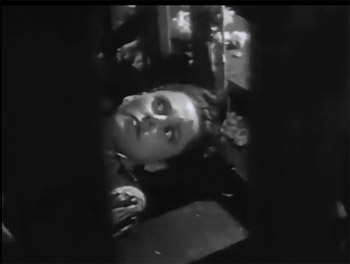
Above: Shots from the cotton-press cliffhanger.
Clayton Moore is perfectly cast in the serial's title function; few other chapterplay leading men could have carried off the part of an ex-outlaw hero so convincingly. Though he's affable in respites from action, and convincingly earnest near his want to exit his dark by backside, he also gives his Jesse a steely but intense demeanor that makes the existence of said past quite believable; the intense and almost murderous glares he bestows on heavies and the ferocious swiftness with which he guns them down especially help to requite his characterization a genuinely dangerous edge.

Above: Clayton Moore virtually to nail a fleeing outlaw.
Linda Stirling, who was expecting her first son during the series'due south production and was preparing to go out Republic Pictures for good, has much less to do here than in whatever of her other serials–just yet does it well, reacting to the serial'south action with intelligent business concern and handling her few romantic moments with sidekick John Compton with nifty charm. Compton'due south own performance is but acceptable overall; while he handles his lines with more than vigor than many serials' secondary heroes (his pronounced Tennessee twang giving his delivery added authenticity), he's apparently either unwilling or unable to modify his blandly cheerful facial expression no thing what the situation.

To a higher place: Linda Stirling and John Compton.
Tristram Coffin and Roy Barcroft are well-matched as the series's heavies. Coffin spends most of his screen fourth dimension pacing tensely about his office and snapping out orders with cool but aggressive cocky-assurance, or hoodwinking the protagonists with a straightforward man-of-the-world manner–while Barcroft executes the active villainy in brutishly gleeful fashion and grumbles lazily between assignments; the various interchanges between the two villains, with Barcroft continually muttering "I dunno" in response to Coffin'south precipitous queries, are quite humorous at times without diminishing either grapheme'southward menace. Stocky and tough-looking Holly Blight, somewhat oddly cast as Bury's nervous clerk, frequently sits in on these villainous conferences every bit well; his and Barcroft'south chortling confusion over Coffin'due south latest scheme in Chapter Ten is peculiarly enjoyable.
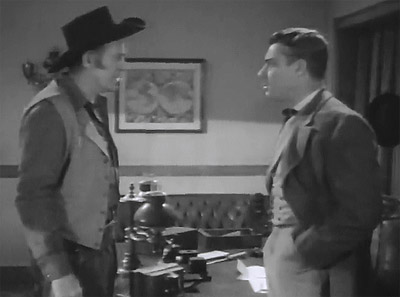
Above: Roy Barcroft (left) and Tristram Coffin.
Tom London is very likable as Linda Stirling's wheelchair-jump but feisty and incurably cheerful male parent, while Edmund Cobb is suitably indomitable as Wilkie, some other of the beleaguered farmers. Ed Cassidy and LeRoy Stonemason pop up in the after chapters as (respectively) a veteran wildcatter and a suave simply non-crooked oil buyer. Venerable silent comic Chester Conklin, one of the old-fourth dimension Keystone Kops, also appears late in the serial as the cook for the oil coiffure, and George Chesebro has a skillful showcase as a henchman terrorized past the "ghost" of Jesse James. Two other veteran henchmen–Charles Male monarch and Monte Montague–pop upward briefly as badmen, as do all the serial's stuntmen, with Fred Graham winning the meatiest role equally a treacherous farmer. The typically dour Keith Richards is unusually lively as a wily "drunken" outlaw, Richard Alexander has a nice bit as a helpful blacksmith, Gene Roth is the town sheriff, Dave Anderson is funny as a dockyard loafer, and Tom Chatterton pops upwardly at the end for a cursory simply fantabulous plow equally grizzled Missouri sheriff Mark Tobin.
With its above-average action, its strong cast, and its interestingly offbeat premise, Jesse James Rides Again ranks as i of Democracy's best mail service-Golden Historic period Western serials, comparing quite favorably with earlier and more expensively-produced 1940s outings like Daredevils of the W. Like several other chapterplays from Republic's early mail service-war years, Jesse is oftentimes underrated or disregarded, only is commencement-rate nonetheless.

Above: A skilful shot of Clayton Moore and horse against the Iverson skyline.
Source: https://filesofjerryblake.com/2013/10/21/jesse-james-rides-again/
0 Response to "Jesse James Rides Again Chaper Twelve"
Post a Comment