Python Read in Csv the Right Way
Python CSV library provides the functionality to read and write CSV files. Information technology is specifically designed to work out of the box with Excel-generated CSV files; information technology is effortless to work with a variety of CSV formats.
Exchanging information through text files is the standard way to share info between programs and one of the well-nigh pop formats for transferring data in the CSV format.
You don't need to build your own CSV parser from scratch. At that place are acceptable standard libraries you tin can utilize.
In this mail, yous will learn how to read, process, and parse the CSV files using Python. You will see how CSV files work, learn the all-importantCSV library congenital into Python.
What is a CSV File?
CSV(Comma Separated Values) files are used to store a large number of variables or information. They are incredibly simplified spreadsheets think Excel, only the content is stored in plaintext. Python CSV module is a built-in office that allows Python to parse these types of files.
The text inside the CSV file is laid out in rows, and each of those has columns, all separated by commas.
Technically in CSV files, the first row is column names in SQL tables, and then the other rows are the data co-ordinate to the columns.
Every line in a CSV file is a row in the spreadsheet, while the commas are used to ascertain and separate cells.
The structure of the CSV file is following.
column ane name,column 2 proper name, column 3 name first row information 1,first row data two,first row data 3 second row data 1,2nd row data 2,second row data 3 third row data ane,3rd row data ii,3rd row information 3 fourth row data ane,fourth row data 2,quaternary row data three
Parsing CSV Files with inbuilt CSV Library
Python CSV module includes all the necessary functions.
The CSV part list is following.
- csv.reader()
- csv.writer()
- csv.register_dialect()
- csv.unregister_dialect()
- csv.get_dialect()
- csv.list_dialects()
- csv.field_size_limit
Python CSV Instance
Python CSV module contains the objects and other code to read, write, and process data from and to the CSV files.
Let's read and write the CSV files using the Python CSV module.
Reading CSV Files
If we demand to pull the information from the CSV file, you must use the reader role to generate the reader object.
The reader function is formed to take each line of the file and make the list of all columns. Then, you choose the column y'all want a variable data for.
The CSV file is opened every bit the text file with Python'southward congenital-inopen() office, which returns the file object. This is and so passed to the reader, which does the heavy lifting.
The syntax for reading a CSV file in Python is the post-obit.
import CSV With open('some.csv', 'rb') every bit f: reader = csv.reader(f) for row in reader: print row Permit'due south see the post-obit example.
Let's create a CSV file chosendata.csvand add the following content.
column 1 proper name,cavalcade 2 proper noun, cavalcade iii proper name first row information ane,first row data 2,first row data three second row data 1,second row data 2,second row data iii 3rd row data 1,tertiary row information 2,third row data iii fourth row data 1,fourth row information 2,fourth row data 3
In the aforementioned directory, create a file calledapp.pyand add the post-obit code inside that file.
# app.py import csv with open('data.csv') as csv_file: csv_reader = csv.reader(csv_file, delimiter=',') line_count = 0 for row in csv_reader: if line_count == 0: impress(f'Column names are {", ".join(row)}') line_count += i else: print(f'\t{row[0]} works in the {row[ane]} department, and was born in {row[2]}.') line_count += 1 print(f'Processed {line_count} lines.') Notice the first line of code is used to import the CSV module.
Then we accept used theopen()function and pass the file which we need to read and and then use theCSV module's reader office to create an object and iterate that object to get the row and columns.
Each row returned by thereader is the list ofCord elements containing the data found by removing the delimiters.
The start row returned contains the column names, which are handled in a special fashion.
Meet the output below.

See in the output; we accept differentiated the columns names and rows data.
Optional Python CSV reader Parameters
Thereader object can handle the different styles of CSV files by specifying additional parameters, some of which are shown below:
- Thedelimiter specifies the character used to divide each field. The default is the comma (', ').
- The quotechar specifies the unique grapheme used to surroundings fields that incorporate the delimiter character. The default is the double quote (' " ').
-
Theescapechar specifies the character used to escape the delimiter character, in case quotes aren't used. The default is no escape character.
Writing to CSV Files
You can also write to the CSV file using thewriter object and the.write.row() method.
If the writing file has not been created, then it will be automatically created. Allow's see the following case.
# app.py import csv with open('student.csv', mode='w') as student_file: student_writer = csv.author(student_file, delimiter=',', quotechar='"', quoting=csv.QUOTE_MINIMAL) student_writer.writerow(['Krunal Lathiya', 'GTU', 'Exist']) student_writer.writerow(['Ankit Lathiya', 'GTU', 'MCA']) print('Writing has been completed') In the above lawmaking, nosotros accept not created the student.csvfile, still created a writer object and written the two rows.
Run the file and see the output.
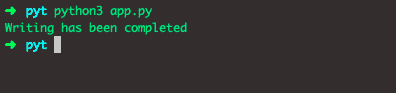
Y'all tin can run into thepupil.csvfile inside your project directory.
Krunal Lathiya,GTU,Exist Ankit Lathiya,GTU,MCA
Thequotechar is an optional parameter that tells thewriter object which characters to use to quote fields when writing the file.
Whether quoting is used or non, however, is determined past an optional quoting parameter:
- Ifquoting is set to thecsv.QUOTE_MINIMAL, then.writerow() volition quote fields only if they contain adelimiter or aquotechar. This is by default case.
- Ifquoting is gear up to thecsv.QUOTE_ALL, then.writerow() volition quote all the fields.
- Ifquoting is set to thecsv.QUOTE_NONNUMERIC, and so.writerow() volition quote all the fields containing the text data and catechumen all numeric fields to afloat information blazon.
- Ifquoting is set to thecsv.QUOTE_NONE, then.writerow() volition escape delimiters instead of quoting them. In that case, you as well must provide the value for the escapecharoptional parameter.
Finally, the Python CSV Case is over.
Source: https://appdividend.com/2019/01/22/python-csv-tutorial-reading-and-writing-csv-files-in-python/
0 Response to "Python Read in Csv the Right Way"
Post a Comment